
Latin American mining valuations fall in November, but parent stakes blur the ranking
The November snapshot spans several commodities, but two parent companies also own listed miners counted separately.
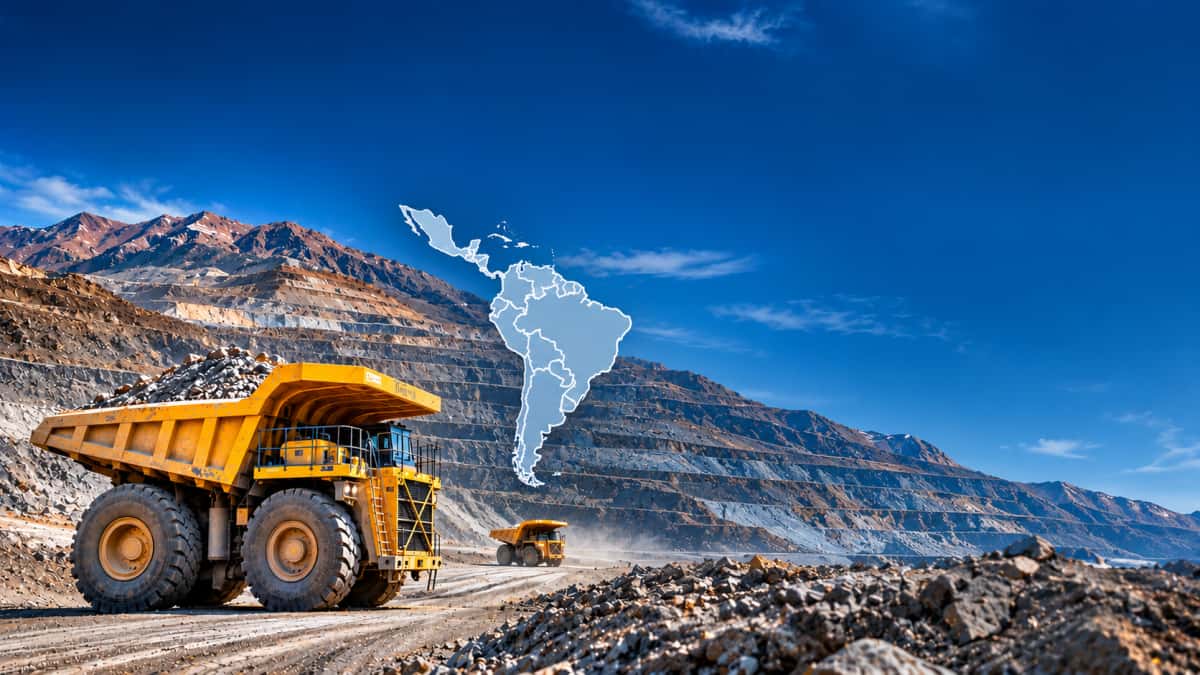
Why it matters: Market capitalizations show how investors value listed miners, but parent-subsidiary overlaps can make comparisons misleading if valuations are simply added.
US$120.0 billion — Southern Copper’s approximate market capitalization on November 25–26.
US$81.2 billion — Grupo México’s approximate market capitalization in the same snapshot.
US$41.7 billion — Vale’s approximate market capitalization.
21.9% — Antofagasta’s approximate decline from its November 13 valuation.
The largest listed mining companies linked to Latin America had lower market capitalizations in a November 25–26 snapshot than in reference figures from November 13. Southern Copper ranked first at approximately US$120.0 billion, followed by Grupo México at US$81.2 billion and Brazil’s Vale at US$41.7 billion. The comparison covers eight selected companies with comparable valuations; it is not an exhaustive regional ranking.
The eight-company ranking
| Rank | Company | Regional link | Approx. market capitalization | |---:|---|---|---:| | 1 | Southern Copper | Mexico / Peru | US$120.0 billion | | 2 | Grupo México | Mexico | US$81.2 billion | | 3 | Vale | Brazil | US$41.7 billion | | 4 | Antofagasta plc | Chile | US$32.4 billion | | 5 | Fresnillo plc | Mexico | US$20.9 billion | | 6 | Industrias Peñoles | Mexico | US$14.1 billion | | 7 | SQM | Chile | US$13.7 billion | | 8 | Buenaventura | Peru | US$5.15 billion |
The figures are approximate and in US dollars. The ranking is based on companies’ strong corporate or operational links to Latin America, regardless of where they are legally incorporated.
Parent-company stakes complicate comparisons
Grupo México controls a majority stake in Southern Copper, so the two companies’ market capitalizations overlap in part. Adding them together would count some of the same underlying economic value twice. A similar issue applies to Industrias Peñoles, which controls Fresnillo.
The rankings therefore describe the market value of each listed company, not a combined value for separate, fully independent asset bases. Grupo México also has railway and infrastructure businesses alongside mining, giving it a broader mix of operations than a copper-focused producer.
The leading positions reflect the region’s exposure to different commodities. Southern Copper operates Buenavista del Cobre and La Caridad in Mexico, and Toquepala and Cuajone in Peru. Vale, whose production is anchored by operations in Carajás and Minas Gerais, is a major iron ore producer and also participates in nickel and copper. Antofagasta’s four principal mining operations—Los Pelambres, Centinela, Antucoya and Zaldívar—are in Chile, although the company is incorporated in the United Kingdom and listed in London.
The list also includes Mexican gold and silver producers Fresnillo and Peñoles, Chilean lithium producer SQM, and Peru-focused Buenaventura, with exposure to gold, silver, copper and other metals. Their valuations reflect different commodity exposures and cannot be read as a direct comparison of production, reserves or operating scale.
November declines do not measure changes in assets
All eight companies had lower reference market capitalizations in the November 25–26 snapshot than on November 13. The approximate declines ranged from 10.5% for SQM to 21.9% for Antofagasta; Vale fell about 14.0%, while Southern Copper and Grupo México declined about 13.2% and 12.4%, respectively. The figures were rounded and captured at different update times.
A lower market capitalization does not by itself indicate an equivalent reduction in mineral reserves, productive capacity or physical assets. Nor is Codelco included: as a state-owned Chilean company, it has no directly comparable public-market capitalization. Its scale is assessed through measures such as production, assets, reserves, earnings and debt rather than a listed share value.
More in Mining Stocks
Harmony Gold passes AGM resolutions, but two director re-elections draw less support
A cash-share authority sat alongside board renewals, while Harmony’s next use of that mandate remains undecided.
Silverco completes first full operating quarter as La Negra and Cusi target 2027
La Negra is producing in Mexico, while Cusi’s restart depends on commissioning work still under way.
Orvana EBITDA nearly quadruples, but Spain gold output is set to fall in 2027
Bolivia’s oxide circuit is still ramping up as EMIPA’s remaining bondholders weigh options ahead of a February maturity.