
Eagle Nuclear joins Russell Microcap, but its SMR strategy lacks disclosed terms
The index move puts Eagle’s Oregon uranium position in focus, but adjacent Cordex remains unquantified.
cruxinvestor.com
Why it matters: Russell membership may broaden Eagle Nuclear’s visibility, but it does not itself fund development of the company’s Oregon uranium assets or its reactor-technology plans.
December 11, 2026 — scheduled date for Eagle’s Russell Microcap inclusion, after the US market close.
32.75 million pounds — indicated uranium resources reported at the Aurora deposit in Oregon.
4.98 million pounds — inferred uranium resources reported at Aurora.
Approximately US$9 trillion — assets the company says are benchmarked to US Russell indexes, not investment committed to Eagle.
Eagle Nuclear Energy Corp. is scheduled to join the Russell Microcap Index after the US market closes on December 11, 2026, as part of FTSE Russell’s annual reconstitution. The company said it expects to remain in the index for one year and to be included automatically in the corresponding Russell growth and value indexes.
The addition is a capital-markets development for the uranium explorer, rather than a change to the development status of its projects. Russell eligibility is based primarily on market-capitalization rankings and style criteria. The company’s material puts the assets benchmarked to US Russell indexes at approximately US$9 trillion, but that figure does not represent a direct investment in Eagle or guaranteed buying of its shares.
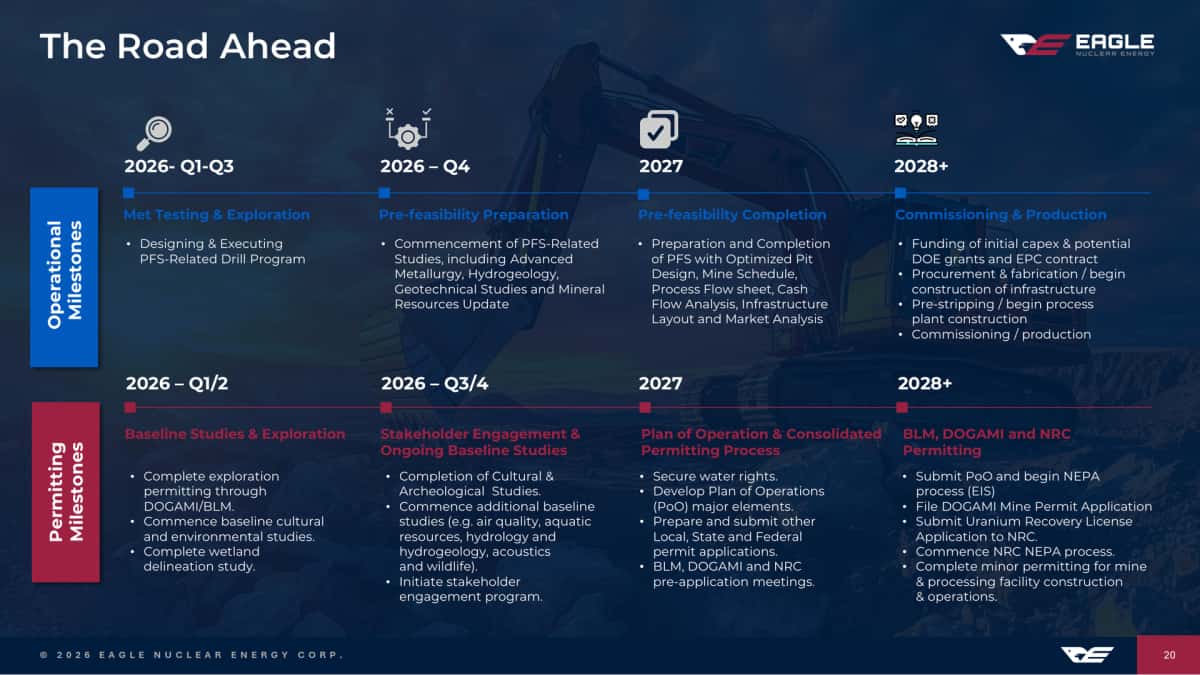
Aurora is the quantified part of Eagle’s Oregon position
Eagle reports 32.75 million pounds of indicated resources and 4.98 million pounds of inferred resources at its Aurora deposit in southeastern Oregon, under the classification cited in an S-K 1300 technical report. The company describes the deposit as near surface. The announcement does not provide the resource-estimation parameters, extraction costs or a development schedule.
Adjacent to Aurora, the Cordex deposit could add to the project’s resource inventory, Eagle said, but the company did not quantify a potential addition. Eagle also describes itself as owning the largest conventional measured and indicated uranium deposit in the United States. That is the company’s characterization; the announcement does not provide a comparison with other deposits.
The reactor-technology link remains unspecified
Eagle’s strategy combines domestic uranium exploration with access to small modular reactor (SMR) technology. The company has not identified the technology, disclosed the terms of any access agreements or explained how it might be integrated with its Oregon assets. Its chairman and chief executive, Mark Mukhija, said the index inclusion could increase visibility for the company and its uranium and advanced nuclear technology projects.
The wider US nuclear context includes the Nuclear Regulatory Commission’s September 29, 2026, construction permit for the Tennessee Valley Authority’s BWRX-300 reactor at Clinch River, Tennessee. It was the first authorization in the United States for that reactor design. In Canada, Ontario Power Generation received a construction licence for a BWRX-300 at Darlington in April 2025, and construction is under way.
Promotion disclosure and remaining details
The promotional material accompanying Eagle’s announcement stated that it was paid content reviewed and approved by the company and a marketing firm, and disclosed a conflict of interest related to compensation for its distribution. That disclosure is relevant when assessing the company’s descriptions of its assets and strategy.
The index entry is scheduled for December 11; the announcement provides no new resource estimate for Cordex and no details on the terms or stage of Eagle’s proposed SMR technology access.
More in Mining Stocks
Plansee launches Molymet bid, but control hinges on shareholder threshold
The Austrian group already owns a strategic stake, yet the offer’s minimum acceptance condition leaves the next step with Molymet investors.
Argentina approves RIGI incentives for YPF’s US$50.75bn LNG plan, but FID remains
The plan would link Vaca Muerta gas to offshore liquefaction units, while the partners still face a final capital commitment.
Vår Energi’s Ekofisk deal expands North Sea reach, pending 2027 clearance
The package links Norwegian production with a UK export terminal, but the transfer still needs government and regulatory approval.