
CiDi unveils cabless mine truck as fleet-wide autonomy faces a test
The first unit is bound for a Xinjiang mine, while CiDi’s software pitch depends on linking trucks, drills and workers across different systems.
cidi.ai
Why it matters: CiDi is trying to move mine automation beyond individual vehicles, but integrating mixed fleets will depend on how its systems perform in operating mines.
100 tonnes — CDK155’s stated payload capacity.
1,056 kWh — the truck’s battery capacity, according to CiDi.
More than 35 mines — the company’s reported V2X deployment in China.
CiDi, a Hong Kong-listed technology company, unveiled the cabless CDK155 autonomous electric mining truck and its Yura artificial intelligence agent at bauma CHINA 2026 in Shanghai. The presentation also included an underground drilling robot, vehicle-to-everything (V2X) communications and systems designed to add intelligent functions to existing fleets.
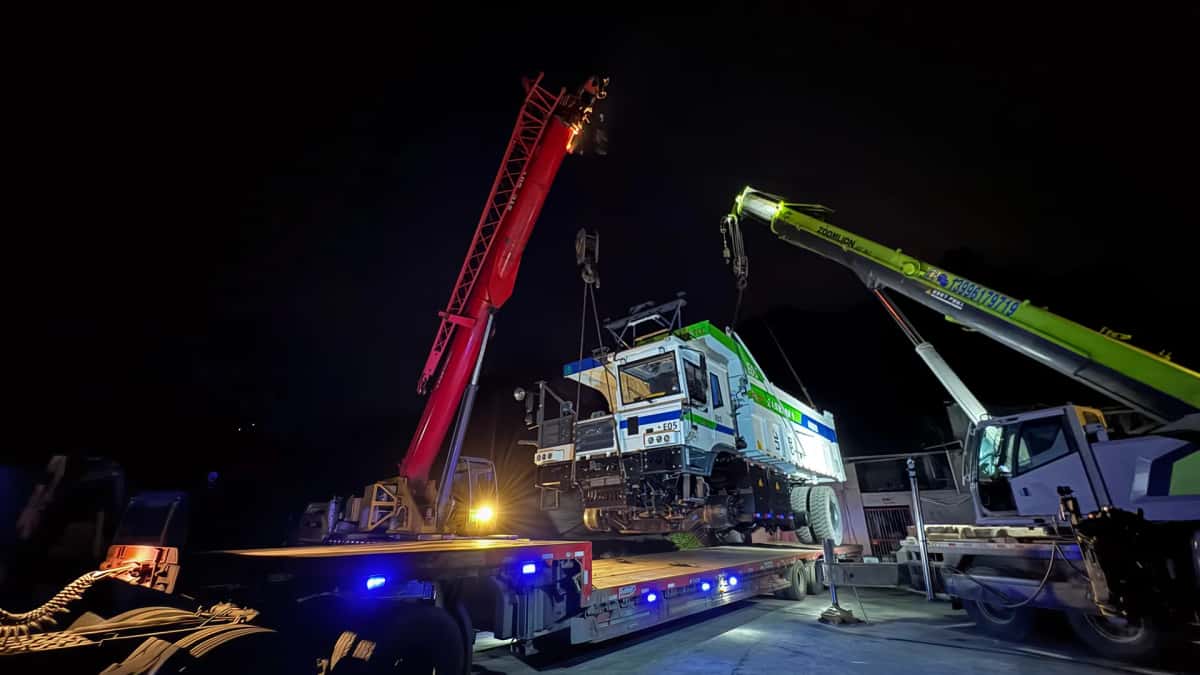
The company’s broader proposition is to coordinate equipment and processes across a mine rather than automate vehicles individually. CiDi says the first CDK155 has been built with a manufacturing partner in Shaanxi province and will be sent to a mine in Xinjiang for testing. It has not specified when trials will begin or how long they will run.
CDK155 combines electric power with autonomous operation
CiDi says the second-generation truck has a 100-tonne payload and a 1,056 kWh battery. It supports both charging and battery swapping, and the company reports that charging from 20% to 80% can take 18 minutes.
The truck is designed without a conventional cab and includes predictive maintenance, terrain adaptation and multi-vehicle coordination, according to CiDi. The company also claims a 10% increase in payload capacity, 15% fewer components, a 20% improvement in service life and a 10% reduction in maintenance and operating costs compared with conventional trucks in its class. The information presented did not specify the comparison conditions behind those percentages.
Yura and V2X target coordination across mine operations
Built on CiDi’s MetaMine platform, Yura accepts natural-language instructions and translates them into tasks for equipment including autonomous trucks, electric shovels and drilling machines. The intended workflow spans drilling, blasting, loading, hauling, dumping and energy replenishment. CiDi did not detail which decisions the agent can execute independently and which require human approval.
Its V2X system connects vehicles, infrastructure, workers and cloud systems. Listed applications include collision alerts, warnings at blind spots and curves, and coordination between excavators and autonomous trucks. CiDi says the system supports direct communications with millisecond latency; worker terminals can send two-way alerts and trigger emergency stops, including in areas with limited or no connectivity. The company reports deployments at more than 35 mines in China, with nearly 5,000 units installed.
Underground robot and software platform extend the offer
The CT17-1S is designed for drilling and excavation in underground conditions involving dust, noise, unstable rock and potentially hazardous gases. It combines remote operation with semi-autonomous excavation and autonomous drilling. CiDi says its perception systems can navigate and avoid obstacles in low light without satellite positioning. The company did not provide figures for any reduction in worker exposure or accidents.
MetaMine connects equipment from different manufacturers and configurations, while Gravicortex provides a common technology base for CiDi’s autonomous-driving, robotics and intelligent-hardware businesses. CiDi says the architecture is designed to coordinate fleets of up to 1,000 vehicles and that MetaMine has operated in more than 40 mines worldwide, connecting more than 1,000 pieces of equipment at peak periods.
The portfolio also includes IPUr, an in-vehicle computing unit intended to add perception and L4-level safety functions to existing vehicles. CiDi reported more than 500 cumulative autonomous freight-transport deliveries and outstanding orders at the end of October 2026. The company’s next stated step for the CDK155 is testing at the Xinjiang mine; no trial schedule or performance criteria have been disclosed.
More in Frontier Mining
Boonray and Vale Indonesia move Sulawesi battery trucks toward implementation
Charging infrastructure and remote-operation systems are included, but the companies have not disclosed the fleet size or launch schedule.

Emerson and Databricks target industrial AI, but deployment details remain unclear
AspenTech’s software is intended to connect operational data with business decisions, but the companies have not outlined how customer rollouts will work.
U.S. awards Samoa seabed leases as Earthjustice seeks to overturn sale
A federal court ruling on endangered-species protections is central to a pending bid to undo the sale.