
Australian Gold and Copper's Evergreen hit leaves deeper continuity untested
Wet-ground limits shaped earlier drilling; the next phase is intended to test how far the mixed-metal system continues.
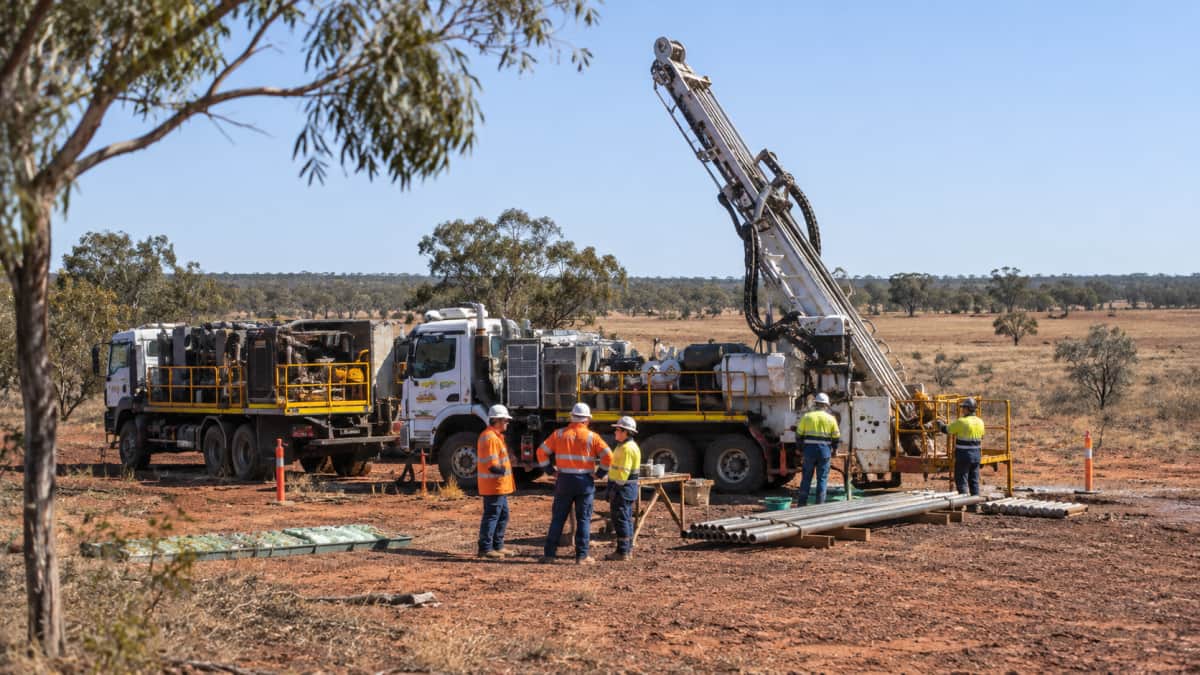
Why it matters: The assays add evidence of precious- and base-metal zones at Evergreen, but their scale and continuity remain to be established.
15 metres — EGRC019 interval grading 4.0 g/t gold and 129 g/t silver from 115 metres downhole
21 holes and 2,593 metres — the completed reverse-circulation program at Hillston
More than 600 metres — the reported strike extent of Evergreen’s main zone
Up to 33 holes — authorised for the next drilling phase
Australian Gold and Copper (ASX: AGC) reported a 15-metre polymetallic interval at its Evergreen prospect in New South Wales, with EGRC019 grading 4.0 g/t gold, 129 g/t silver, 0.5% copper, 5.7% zinc and 4.8% lead from 115 metres downhole. The assays, reported on November 26, 2026, come from the final stage of a reverse-circulation program at the Hillston area of the South Cobar project.
The company said the interval includes 10.5% combined zinc and lead. Reported lengths are downhole intervals and may not represent true widths. The results establish a mix of precious and base metals in the drilled zone, but do not by themselves determine the geometry or economic potential of the mineralisation.
EGRC019 contains distinct precious- and base-metal zones
Within the main EGRC019 interval, a four-metre section from 118 metres graded 10.1 g/t gold and 158 g/t silver. A separate four-metre interval from 122 metres returned 1.1 g/t gold, 97 g/t silver, 1.2% copper, 10.3% zinc and 9.1% lead. The company also reported eight metres grading 2.6 g/t gold and 25 g/t silver from 81 metres in an oxide zone.
Other holes returned additional mineralised intervals. EGRC020 intersected 12 metres from 108 metres grading 0.8 g/t gold, 57 g/t silver, 0.1% copper, 1.9% zinc and 3.8% lead. EGRC021 returned eight metres grading 1.1 g/t gold from 54 metres, including one metre at 4.8 g/t gold.
The distribution of these grades points to sections with stronger precious-metal values alongside intervals richer in base-metal sulphides. The company said the results will inform its geological interpretation; mineralogical characteristics and recoveries have not yet been established.
Hillston sits within a broader mineralised corridor
Since acquiring Evergreen in 2025, Australian Gold and Copper has expanded the reported strike extent of the main zone from about 150 metres to more than 600 metres. At Hillston, drilling has tested more than 250 metres and the company interprets two to three mineralised lenses. The prospect is part of the Browns Reef–Evergreen corridor, which extends for about six kilometres; that corridor length does not mean mineralisation is continuous throughout.
The November results follow a September diamond-drill intersection at Evergreen. Hole 26DDBR017 returned 17 metres from 128 metres grading 5.3 g/t gold, 163 g/t silver, 0.8% copper and 17.3% combined zinc and lead. It included eight metres at 10.4 g/t gold, 311 g/t silver, 1.2% copper and 29% combined zinc and lead.
Deeper drilling planned for 2027
Australian Gold and Copper has regulatory approval for a third phase of up to 33 holes, which it expects to begin in the first quarter of 2027. Wet ground during the previous campaign required smaller-capacity rigs and generally limited drilling to depths near 150 metres. The company plans to use more powerful reverse-circulation rigs in the next phase to investigate deeper extensions.
The work is intended to test continuity, refine the structural interpretation and support a first mineral resource estimate for Evergreen. The company also holds the nearby Achilles discovery, which has an initial resource estimate of 38.5 million ounces of silver equivalent, 58% classified as Indicated. Evergreen’s next drilling phase will determine whether the mineralised intervals extend at depth; no resource estimate for Evergreen is reported in the available results.
More in Discoveries
Lion One hits 44.39 g/t gold at Tuvatu as Zone 500 continuity remains unproven
The first targeted drilling there since 2022 is probing whether deep structures extend beyond previously tested areas.
Founders Metals extends Froyo gold zone at Antino, but deep continuity remains unproven
Three completed deep holes could show whether the gold-bearing structure persists below the latest intercept.
Cascadia's Carmacks drilling challenges the 2022 resource boundary in Yukon
Fifteen assays remain pending as the company tests whether the expanded footprint can support a larger resource.