
Cascadia's Carmacks drilling challenges the 2022 resource boundary in Yukon
Fifteen assays remain pending as the company tests whether the expanded footprint can support a larger resource.
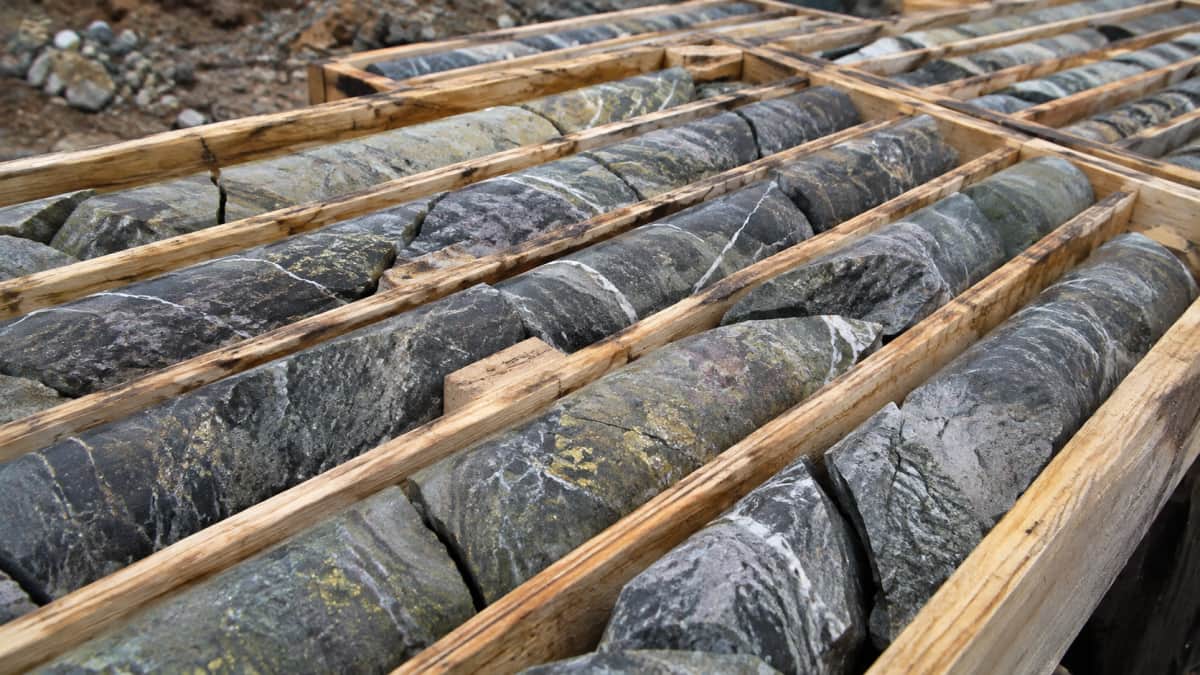
Why it matters: The drilling tests whether a larger copper-gold footprint can add scale to Carmacks' existing resource base.
73.65 metres — CD-26-064 grading 0.95% copper and 1.05 g/t gold
About 400 metres — northward extension of the 2000S mineralized zone beyond the 2022 resource model
18,242 metres — total drilling completed in 2026, with 15 assays pending
Cascadia Minerals has extended mineralization at the 2000S zone at its Carmacks project in Yukon about 400 metres north of the 2022 resource model, toward the 147 zone. The company reported the results on November 25, including a 73.65-metre interval grading 0.95% copper and 1.05 g/t gold in hole CD-26-064. The zone’s known extent now exceeds 700 metres, compared with about 300 metres previously identified.
The intercept also returned 6.7 g/t silver and 466 ppm molybdenum, for a reported 2.03% copper-equivalent grade calculated using project metal-price and metallurgical-recovery assumptions. These are downhole lengths, not true widths; the company estimates true widths at 60% to 70% of the reported intervals.
CD-26-064 includes a higher-grade interval
Within the main intercept, CD-26-064 cut 52.27 metres grading 1.22% copper, 1.43 g/t gold, 9 g/t silver and 615 ppm molybdenum. The company reported a copper-equivalent grade of 2.68% for that interval. The main mineralized section was intersected between 322.21 and 395.86 metres down the hole.
Two other holes also tested the northern expansion. CD-26-060 returned 51.43 metres grading 0.61% copper and 0.44 g/t gold, including 19.92 metres at 1.15% copper and 0.83 g/t gold. CD-26-061 intersected 13.60 metres grading 0.93% copper and 0.55 g/t gold, about 400 metres north of the boundary of the 2022 modeled resource.
Results were weaker at the Zone 14 target, about 500 metres east of Zone 1213: two holes returned 0.19% copper over 10.13 metres and 41.36 metres, respectively.
Existing resources and preliminary economics
Carmacks’ current estimate contains 36.3 million tonnes of Measured and Indicated resources grading 0.81% copper and 0.26 g/t gold, alongside about 2.9 million tonnes of Inferred resources grading 0.60% copper and approximately 0.14 g/t gold. The Measured and Indicated material contains an estimated 651 million pounds of copper and 302,000 ounces of gold. The new drilling has not yet been incorporated into a formal resource update.
A 2023 preliminary economic assessment considered open-pit mining and conventional flotation at a processing rate of 7,000 tonnes per day over a nine-year mine life. It estimated initial capital of about C$200 million and, using assumed prices of US$4.25 per pound of copper and US$2,000 per ounce of gold, an after-tax net present value of about C$330 million and a 38% internal rate of return. Those estimates reflect the study’s earlier resource and assumptions; they are not updated project economics or a construction decision.
Pending assays will inform the next resource update
Cascadia completed 39 diamond drill holes totalling 18,242 metres in 2026, ending drilling in mid-October. Fifteen holes still awaited laboratory results when the company reported the latest assays. Five of those holes targeted the 2000S expansion and intersected sulphide mineralization, but their grades were not yet available. Results were expected in January 2027.
The company is considering about 20,000 metres of additional drilling in 2027 and plans to advance a resource update. Incorporating the new mineralization will depend on geological interpretation, continuity and grade distribution. Carmacks has road access, a 40-person camp and is about 10 kilometres from grid power, but its Class 4 exploration authorization, valid to 2035, is not a permit to build and operate a mine.
More in Discoveries
Lion One hits 44.39 g/t gold at Tuvatu as Zone 500 continuity remains unproven
The first targeted drilling there since 2022 is probing whether deep structures extend beyond previously tested areas.
Founders Metals extends Froyo gold zone at Antino, but deep continuity remains unproven
Three completed deep holes could show whether the gold-bearing structure persists below the latest intercept.
Auric Mining’s Munda drilling finds shallow gold the pit model may miss
Western-edge holes test the second-stage pit design, while mineralisation below its planned limits could change the deposit’s mining envelope.