
Could one 1,500 kW mining machine match Putaendo’s household power use?
Chile’s falling ore grades are pushing plants to handle more rock, while the case for larger processing capacity competes with the search for better deposits.
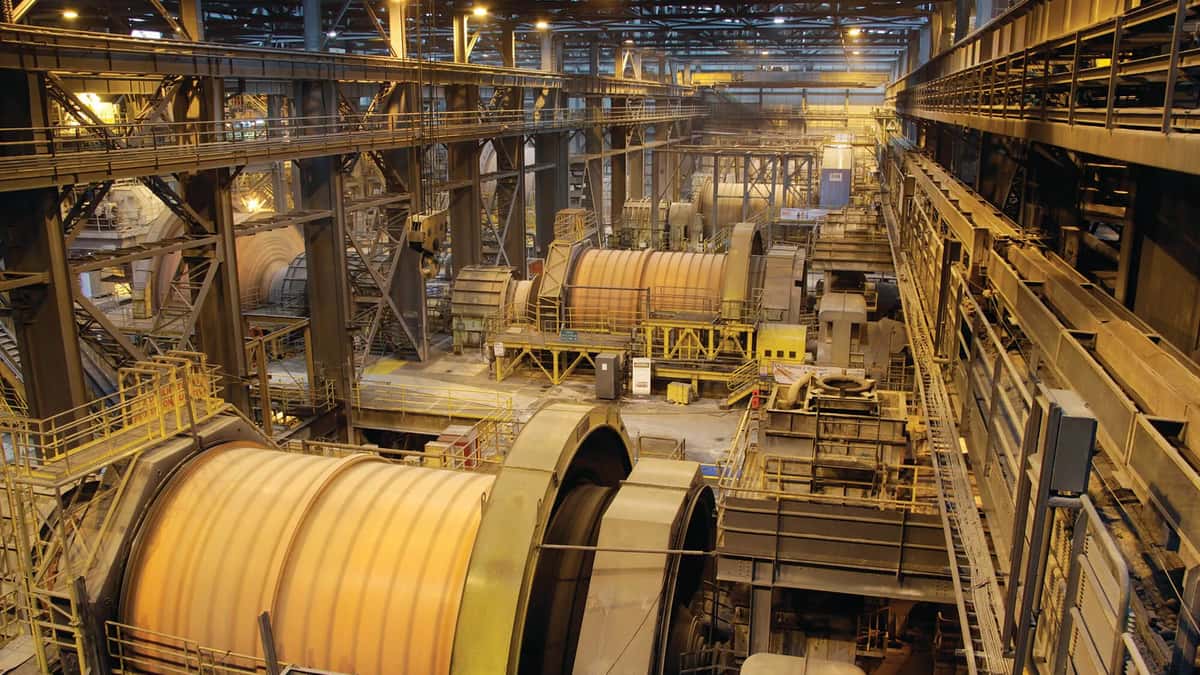
Why it matters: Lower copper grades make production more dependent on processing capacity, but more throughput can bring higher energy and operating demands.
1,500 kW — the capacity of the machine used in the comparison
1.08 million kWh — its theoretical monthly use at full load, around the estimated consumption of 6,000 homes
1.13% to 0.58% — Chile’s average copper grade treated, from 2002 to 2025
US$874.7 million — Chile’s exploration budget in 2025, with 51.4% allocated to existing mines
A 1,500 kW mining machine running continuously at full load for 30 days would use about 1.08 million kilowatt hours (kWh)—roughly the estimated monthly electricity consumption of 6,000 Chilean households. Putaendo, in the Valparaíso Region, recorded 6,037 households in the 2024 Census, putting the hypothetical machine’s demand on a similar scale.
The comparison assumes uninterrupted operation at maximum power and uses 180 kWh per household per month as a reference. It is not a measurement of a particular machine or of Putaendo’s actual electricity use. Nor does it account for the many other machines and auxiliary systems required to run a concentrator.
Lower grades mean more rock for the same copper
The pressure behind the comparison is a long decline in the grade of copper ore treated in Chile. Sector statistics put the weighted average at 1.13% in 2002 and 0.58% in 2025, a drop of about 49%. At those grades, a tonne of ore contains an average of 11.3 kg and 5.8 kg of copper, respectively.
Assuming equivalent recovery, producing the same amount of copper therefore requires processing almost twice as much material at the lower grade. That can increase demands on drilling, blasting, haulage, crushing and grinding, as well as water use, maintenance and tailings management. A larger processing circuit does not necessarily deliver a matching increase in copper output.
The distinction matters when assessing equipment upgrades: lowering the cost per tonne of ore treated does not automatically lower the cost per tonne of copper produced. Rock hardness, mineralogy and metallurgical recovery can all affect the outcome.
Energy demand is rising as production has fallen
The Chilean Copper Commission (Cochilco) reported that copper mining used 210.6 petajoules of energy in 2025, up 27.3% from 2015. Over that period, national copper production fell from about 5.77 million tonnes to 5.39 million tonnes. The energy measure includes electricity and fuels, not just the power used by processing equipment.
Cochilco forecasts electricity demand from copper mining to rise from 27.6 terawatt hours in 2025 to 33.2 terawatt hours in 2034, a 20.2% increase. Its projected production growth over the same period is 8.3%. Concentration is expected to account for 18.1 terawatt hours, or 55% of the sector’s forecast electricity use, in 2034.
Exploration offers a different route to more output
Higher-capacity equipment can help mines respond to lower grades, but the need to move more material also sharpens the case for finding deposits with better characteristics. In theory, a plant treating 1% copper ore would need half the tonnage of one treating 0.5% ore to produce the same amount of contained copper. Actual economics also depend on factors such as depth, haul distance, rock hardness, impurities and recovery.
Chile’s exploration budget reached US$874.7 million in 2025, US$80.7 million above the previous year, according to Cochilco. But 51.4%, or US$449.3 million, went to exploration at existing mines. Initial exploration received US$206.5 million, while advanced and feasibility-stage programs accounted for US$218.9 million.
Exploration near operating mines can extend their lives and make use of existing infrastructure, but does not necessarily identify new mining districts. The investment challenge is to balance upgrades that sustain current operations with earlier-stage exploration that could find new sources of ore. Any proposed expansion must also be tested against the operation’s energy supply, recovery performance and the characteristics of the mineral resource.
More in Resources

Codelco’s 2026 forecast points to a 30-year low despite added divisions
Three divisions now in Codelco’s portfolio were not operating when the state miner last produced at a comparable level.
Codelco trims 2027 copper premiums for China as Yangshan hits a record
The Shanghai contract talks opened after Chinese imports of Chilean cathodes fell sharply, putting annual sales and spot-market signals at odds.
Codelco lowers 2027 China copper offers as Chilean cathode imports fall
Some Chinese buyers considered leaving annual contracts, putting Codelco’s next terms in play as a wider supply benchmark.