
AMTC model simulates 88% copper recovery, but mine-scale validation remains
The model combines heat, irrigation and salinity in heap-leach forecasts, but its particle-size basis differs sharply from the experimental comparison.
Why it matters: The model could help narrow operating conditions for copper heaps, but its projections do not yet establish industrial performance or economic returns.
Up to 88% — simulated copper recovery in the highest-recovery scenario.
1,000 days — modelled heap-leach period, calculated in about 12 minutes on a desktop computer.
0.3% copper — grade used in the modelled ore, equivalent to three kilograms per tonne.
19.05 mm — particle size in the heap simulations, compared with 150–180 micrometre particles in the experimental data used for comparison.
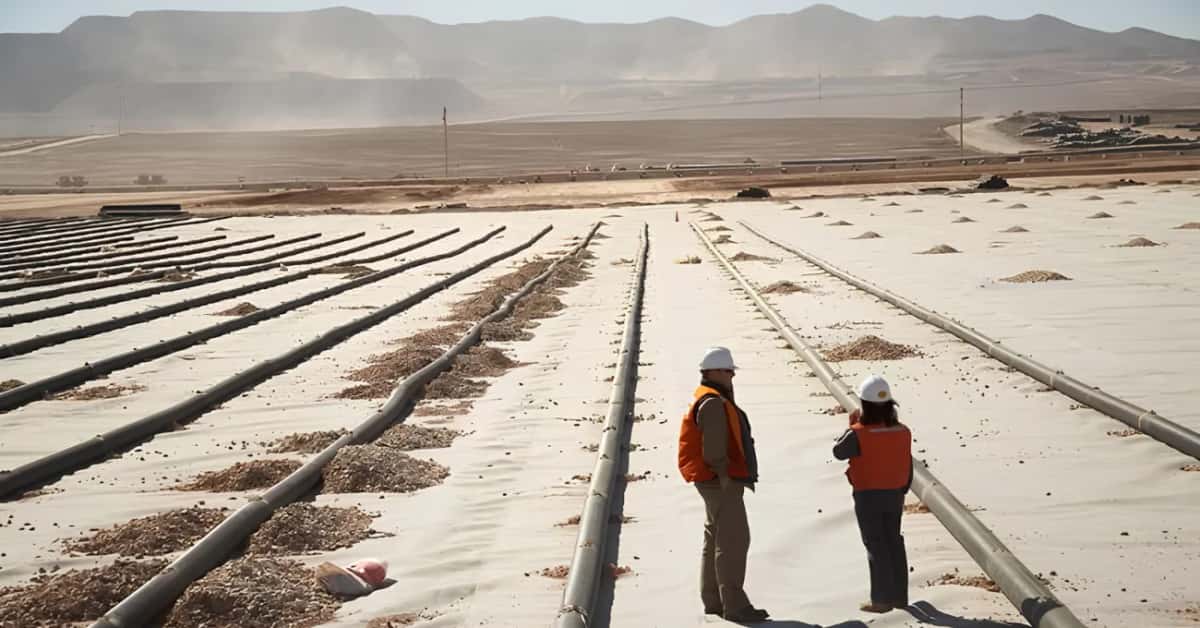
Researchers at the Advanced Mining Technology Center (AMTC) at the University of Chile simulated copper recovery of up to 88% through chloride heap leaching. The model represents a 10-metre-high pile covering one hectare and calculates how solution flow, mineral dissolution and heat move through it over 1,000 days. The result is a modelled outcome, not a recovery rate demonstrated at an operating mine.
Published in Hydrometallurgy, the tool is designed to compare operating scenarios before changes are tested in the field. Chloride leaching, which can use saline or seawater-based solutions, is used at operations including Escondida, Spence and Zaldívar. Its relevance is increasing as near-surface oxide ores are depleted and a greater share of copper comes from more complex sulphide ores.
Heat and chloride concentration shift simulated recovery
The researchers varied chloride and copper concentrations in the solution, irrigation temperature and flow rate, and the use of a thermal cover. Raising chloride concentration from 90 to 150 grams per litre increased simulated extraction from 71% to 76%, with other reference conditions held constant. Raising irrigation temperature from 45°C to 75°C increased the modelled recovery from 71% to 79% in a separate comparison.
A thermal cover kept the pile about 5°C warmer and raised simulated extraction from 68% to 71%, without increasing the solution’s entry temperature. The highest-recovery case combined irrigation at 75°C, 150 grams of chloride and 2.5 grams of copper per litre, a flow rate of 10 litres per square metre per hour, and a thermal cover. Internal pile temperatures in that scenario reached 53–57°C.
The model also showed why a higher solution grade does not necessarily mean more copper recovered. Lower irrigation flow could produce a more concentrated output solution while yielding less total recovered metal. Flow affects the transport of substances as well as heat and oxygen delivery, so solution concentration alone cannot measure total extraction.
Recovery gains still need an economic test
The model estimates heat losses under changing environmental conditions, including season and time of day, and can predict the energy required for a particular pile and ore. It also represents the possible precipitation of jarosite in a sulphate-chloride medium; the iron compound can interfere with leaching. These features let users explore energy needs and chemical effects within the model’s assumptions, but the study does not quantify savings in water, energy or emissions.
AMTC director and study lead Humberto Estay said the tool can identify ranges of operating variables to reach a target recovery over a specified period and support estimates of operating and investment costs. It does not yet identify the most profitable combination. Heating solution, pumping more fluid or adding salts carries costs that must be weighed against the value of additional copper, while a heap operating for 1,000 days ties up infrastructure and resources. Economic optimization may be addressed in a later stage, the study team said.
Particle-size gap leaves mine-scale validation ahead
The experimental comparison used published data for particles measuring 150–180 micrometres, while the simulated heap used 19.05-millimetre particles. Differences in particle size, mineral composition and uneven solution flow at an operating site mean the projections require further testing before they can support industrial decisions. Results for chalcocite also cannot be directly applied to other sulphides, including chalcopyrite, without adding and validating their behaviour.
The AMTC team has identified potential next steps including testing heat recovery from copper-bearing solution leaving the heap and using that heat to warm incoming irrigation, as well as incorporating sensors to calibrate or validate scenarios. Before industrial use, the model’s predictions will need comparison with measurements and costs from a real operation.
More in Resources

Silver mine supply is set to stall, but industrial demand could flip the balance
A sixth annual deficit is projected for 2026, yet the next shift may come from consumption rather than new mine output.
Peru mining investment jumps 40%, but exploration slips in September
Four companies captured nearly two-fifths of spending, while the largest investment category was not the fastest-growing.

Simberi puts AI into gold resource planning as St Barbara prepares to sell its stake
The models now shape ore classification and feasibility work, but their role after the planned handover remains undefined.